Sunday, 5 August 2012
Did you hear that I went to THE OLYMPICS? You have now!
There are very few moments when this blogger is speechless, but as I'm sat here watching the Olympics on TV, all I want to do is cry with happiness and pride over the achievements of our athletes. Since the opening ceremony last Friday, there has been so much to celebrate.
And yesterday evening I was there, in the Olympic Stadium on 'Super Saturday', where I witnessed one of the greatest sporting events in history, the night that Jessica Ennis, Greg Rutherford and Mo Farah all achieved gold medals for Great Britain, helping to celebrate the most successful day in British athletics for over 100 years.
My husband and I were guests of London 2012 sponsors Coca-Cola, a thank-you gift for launching and judging the recent Sustainable Games blogging competition, the results of which I was pleased to announce on the company's website a couple of weeks ago.
Along with our corporate hosts, we were accompanied by competition winner Lucy along with winner-in-reserve, Laura, who received the news of her ticket as a last-minute surprise, when one of the other finalists had to pull out at short notice. Here we are, in high-spirits with our men-folk, in the stadium taking in the excitement of the athletics!
As well as the once-in-a-lifetime chance to watch some amazing sport, it presented a great opportunity to finally witness the background recycling infrastructure that Coca-Cola has helped to create, including the fabulous bins about which I've waxed lyrical for what now feels like months! As we waited to go into the stadium, I couldn't resist the chance to familiarise myself properly with these colourful beauties, which are there to help visitors easily pre-sort paper, plastic packaging, food waste - and even ponchos - from non-recyclable materials.
And to make it even easier for Olympic supporters to work out which receptacle to use, and to minimise contamination levels, the packaging was colour-coded to show its intended destination.
But as I think back to the atmosphere in the Olympic Stadium last night, I don't want to just talk about rubbish!
Goodness no! And I know many of you will now fall off your chairs to such news, but surely you won't be that surprised! This was the Olympics and no way was I going to hang around the bins all evening!
All I really want to do now, is what I have been doing all day, and that's to relive the astounding evening that resulted in athletes' dreams being turned into a reality.
An amazing evening that distinctly made British sports history!
And the evening when I realised that I was most definitely one of the luckiest women alive.
I have had many exhilarating moments since I started The Rubbish Diet, and last night's Thank You present was most definitely the highlight of my time as a blogger. Frankly, it's going to be a tough one to beat!
The atmosphere in the stadium was electric and highly charged wth emotion.
And sat in the thirteenth row, just behind the discus net, I could no longer hold back the tears of overwhelm and national pride as I watched Jessica Ennis complete the 800m stage of her gold medal Heptathlon.
With every stride she took, she was met by the tremendous cheer from thousands of spectators who knew the gold medal was already hers, a cheer that simply grew louder and louder as she closed in on the finishing line.
It was one of the greatest moments in sporting history, which left me feeling very humble at such amazing talent, yet proud to be amongst the 80,000 spectators that witnessed such an achievement, a victorious feeling for the athletes and country.
And the night just got better, with the news that Greg Rutherford had achieved another gold for Team GB in the Long Jump. The music and cheer just kept the beat of Olympic success pulsing throughout the stadium.
That pulse then became faster and faster as we watched Mo Farah put his strength and stamina to the test in the 10,000 metres!
With only three laps to go the commentator urged us to build the cheer and shout for Mo, but we didn't need encouraging at all.
We were already on our feet, waving the flags to the sound of tremendous roars of support, straining our necks to watch the progress on the large screens when the leading athletes were out of our range of sight and applauding with all our might as Mo Farah sped towards the finishing line!
And forgive me as the tears roll down my cheeks again at that all encompassing memory of being in the right place at the right time to celebrate yet another proud moment for one of Great Britain's athletes, achieving his dream and making another moment of Olympic history!
When I first entered the Olympic Park yesterday, I could not even have guessed at the excitement that would come and the feelings of pride, hope and cheer of simply being there!
London 2012, Team GB and sponsors Coca-Cola have created an amazing experience that is really out of this world. Every element of yesterday's sporting extravaganza went like clockwork, from the efforts of the athletes, the helpfulness and humour of the Gamesmaker volunteers and the organisation of London's transport facilities.
And the international spirit was alive and kicking too, as illustrated by this group of Belgian supporters who distracted me to record a message of support for one of their own athletes, a hockey player... delivered in French, to tell him he was king of his sport!
Well, I hope that's what the message said and that they didn't take advantage of my good humour....! Despite their wigs, they look innocent enough...er... don't they? Then again, those cheeky smiles may prove otherwise and somewhere on YouTube there could now be a bizarre video of me repeating a potential Belgian double-entendre in my very best Anglo-French accent!
The photo of these strangers typified the atmosphere yesterday, with smiling faces everywhere I turned.
But the photograph that I love the best, is this one, which demonstrates that it’s not just my geeky interest that prevails when it comes to recycling, it’s rather the olympic spirit of other visitors that were putting the facilities to good use. And this chap was such a good sport for letting me take this picture!
I hope LOCOG achieves its aims of processing at least 70% of its waste through recycling, composting and reuse. Through streamlining its packaging, material choices and provision of the relevant recycling processes Coca-Cola has set some solid foundations that can be replicated elsewhere. As soon as the waste data streams are available, I can’t wait to find out the relevant statistics.
But most of all, at this moment in time, I’m looking forward to more fabulous outcomes from the wonderful athletes and enjoying such great memories for many decades to come.
To witness Jessica Ennis receive her gold medal last night was a tremendous experience that I will never ever forget, and it can only be matched by watching the victory ceremonies for Greg Rutherford and Mo Farah on TV tonight and reliving the events of last night as I typed up this blogpost.
If there is one thing that I took from the experience, it is the appreciation that nurturing a passion, talent and an individual's determination with the right amount of support, coaching and direction, it really is possible to achieve something incredible.
As a mother whose real passion is to create a foundation that helps her children to achieve their own dreams, whatever they may be, it is already evident that the London 2012 Olympics will inspire them in many ways.
And as a 'rubbish blogger', I am now more determined than ever to aim as high as my own abilities will stretch, to encourage more goal-enthused innovators to push towards that ultimate goal of zero waste.
The tears of emotion have stopped now, temporarily.
And as for being speechless, I think I'm now over that!
Clearly!
Good luck Team GB for the rest of the Games!
I know I will remember London 2012 for many decades to come!
Posted by
Almost Mrs Average
4
comments
Labels: Coca-Cola, Greg Rutherford, Jessica Ennis, London 2012, Mo Farah, Recycling, The Olympics, Waste Reduction, Zero Waste
Thursday, 13 October 2011
A rubbish hack to help sort out your waste
Amongst many things, the Dispatches documentary on Monday demonstrated how confused people still are over which packaging can be recycled in their local bins.
Packaging information, especially in relation to plastics, is still inconsistent and even though the on-pack labelling is getting better, for many the uncertainty of what can be recycled locally still pervades like a bad smell.
So if you're one of the hundreds of thousands who are still confused, here are my top tips.
1. Get the latest information from your council
Before you do ANYTHING ELSE, yes, even embarking on reading the rest of this post, get on the blower to your local council, and ask the recycling officers EXACTLY what you should put in your bins. I know it sounds obvious, but if you've been pondering how complicated it all is, this really is the best place to start.
Council information generally describes recyclables by product type and you'll find local authorities mainly fall into two categories; those where you can recycle most types of plastic packaging (and will include yoghurt pots, margarine tubs and fruit punnets) or those that can't, thus limiting your plastics collection to simply bottles (including drinks bottles, detergent bottles, milk containers & toileteries).
If the information isn't clear. Then ask questions so that you are clear on what can\can't be put in your local bins.
Another excellent source at your disposal (please excuse the pun), is the Recycle Now website. You just pop in your postcode and Bob's your uncle, as the system will return the results of what can be recycled at your kerbside, as well as Bring Banks and Household Waste Recycling Centres.
Once you are confident about your council's rules, you will become less reliant on packaging labelling and hopefully less frustrated.
After all, if you can't recycle a plastic fruit punnet through your local collection, you just can't recycle it regardless what message the packaging information might tell you, so don't fall into the trap of getting hot and bothered. Instead try and buy the product loose instead.
2. Find out what the recycling labels really mean.
Even though your local recycling officer is the best source to use, the new on-pack recycling labels can offer some extra help, and that's mainly to raise awareness of the materials used and the likelihood that they can be recycled.
Again, the best place to find out about the labelling guidelines is at the Recycle Now website. Remember, the labelling advice should be followed as a call to action, prompting you to check with your local authority (coming back to point 1) as opposed to a definitive guide in itself.
Once you are familiar with your local rules, even if the packaging doesn't have the correct up-to-date information printed on it you'll be more confident about what you should do. For example, whilst shopping in a supermarket the other day, the own-brand bread packaging showed that it couldn't be recycled, despite the fact that a new in-store collection had been introduced only a month or so earlier, which actually collects packaging film such as bread bags and toilet-roll wrappers.
3. Avoiding packaging that can't be recycled.
With all the controversy surrounding recycling, with its complications, targets and whether it is sorted properly in the first place, it is very easy to lose sight of what we as consumers actually can do to reduce our waste contribution.
We might not feel as though we have much power, but actually we do...lots! There are many small changes that we can make, which can have a huge impact if they are applied across the nation. I'd hoped to include some of these this week on Woman's Hour, but we simply ran out of time. This list is not exhaustive by any means, and should really be considered as a starter for ten....
- Avoid packaging: Buy loose wherever possible, and support independent stores such as Unpackaged, which actively promotes that you use your own containers.
- Switch packaging: If there isn't an unpackaged option, switch products you can't recycle for those that you can. For example one particular major toothpaste brand comes in small thin plastic bottles, made from the same plastic as fizzy drinks bottles and can be recycled widely.
- Choose reusable: You can also reduce your packaging by switching from disposable products to reusable ones and prevent other waste too. Jackie, who was featured in the Dispatches programme, took my advice about ditching floor wipes and bought a reusable mop. This will save her loads of cash as well as reducing the amount of rubbish thrown away. If you're an avid baby wipe user, try using soft washable cloths instead.
- Upcycle: If you can't recycle the packaging or avoid it completely, try upcycling it instead and raise some cash for your favourite charity. Terracycle offers an upcycling service for packaging from brands that include Johnson's baby wipes, Ella's smoothies, Kenco coffee refills and Aquafresh toothpaste tubes and toothbrushes. It's a great scheme for schools and local community groups. The products are turned into new things that are sold on the Terracycle website.
- Split It: If you live in one of the areas that doesn't recycle plastic yoghurt pots, check your supermarket shelves for products that use less plastic. There are pots on the market that now have a thinner plastic liner and a tear-off cardboard outer (just like the one in the photo). These can be separated, with the cardboard being recycled and less plastic actually going to waste. More packaging will move in this direction, especially thanks to innovations such as Split-it, so keep an eye out on the shelves for products that can help you reduce waste.
- DIY: That's right, do it yourself! If you're hacked off with not being able to recycle your ready-meal trays, see if you can save money and waste by making it yourself. Or if you've got a great friend who can really cook, and I mean really cook, invite yourself around and have a great night out instead of worrying about what you're going to do with the dirty plastic tray and ikky film. Then invite them over next week for some beans on toast!
Of course, all I've covered here is just packaging waste. Food waste is much more of a significant issue. If you're interested in tackling that, watch this space as I'll be back soon with more tips on what you can do at home.
____________________________________________________________________
If you missed the Dispatches "Britain's Rubbish" documentary on Monday, it is still available for the next 27 days at 4OD. It's packed with footage about fly-tipping, plastics, recycling systems and politicians arguing their case as well as the story of how Jackie, a mum from Manchester reduced her family's rubbish from 13kg a week to 5kg. I know I'm biased, but for me, that's the best bit. (Just in case you're looking out for it, my appearance is at 15 minutes and 28 minutes into the programme).
If you want to catch up on the Woman's Hour broadcast this week featuring Bob Gordon, Head of Environment for the British Retail Consortium and Liz Goodwin, Chief Executive of WRAP, you can 'listen again' via the BBC Woman's Hour webpage. Just look for the chapter on Zero Waste.
Posted by
Almost Mrs Average
5
comments
Labels: Dispatches, How to reduce waste, Packaging waste, Recycling, The Rubbish Diet Challenge, Woman's Hour, Zero Waste
Monday, 10 October 2011
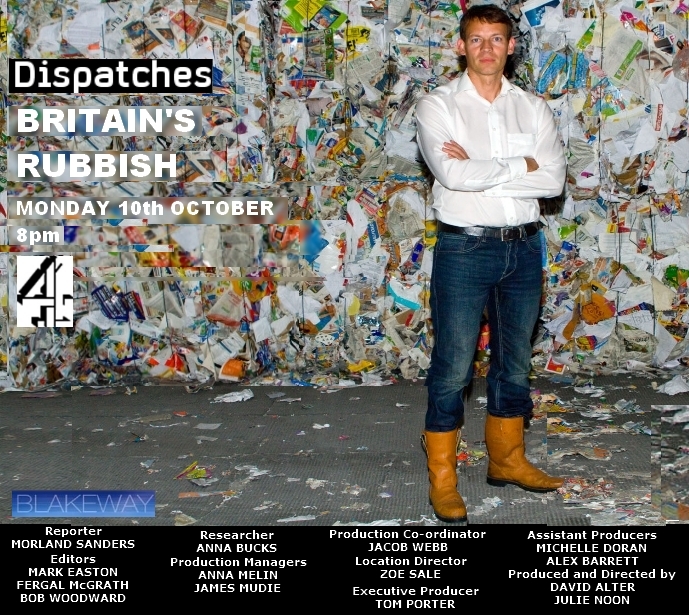
Me being serious on TV: Dispatches, Britain's Rubbish, C4 8pm
| Morland Sanders, investigates Britain's rubbish for C4 Dispatches |
I recently did some filming for the Dispatches documentary that's being broadcast tonight. It's called "Britain's Rubbish" and will be aired at 8pm on Channel 4.
When I was asked to contribute, a huge part of me wanted to batten down the hatches, draw the curtains and say "Thanks but no thanks". I normally stay away from the heavy stuff and regular readers will know I don't normally campaign against issues, but instead promote ideas that help empower householders to reduce waste, even if it's just by a small amount.
But as I was about to say "No thank you" to the documentary makers, my thoughts turned back to why I keep raising awareness of recycling and waste reduction. It's because it really is such a serious issue, despite my own natural tendency towards lightening the mood. And I am still as passionate about getting people to talk about their rubbish as I've ever been. Furthermore I'm a constant troubleshooter, who loves sharing positive information that I've gathered, even if it has turned this average householder into a bit of a waste geek. So, as I gave my reply I found myself changing my mind and saying "yes".
I knew the documentary could offer another avenue to raise awareness of all the advances that have taken place in recent years, including the fantastic On-Pack Recycling Labelling standard that helps shoppers better understand whether an item can be recycled. There's also the news how popular brands have made steady inroads into "lightweighting" packaging, designing out wasteful components as well introducing a greater percentage of recycled materials into their products. Such developments should make it far easier for shoppers to dramatically reduce their waste.
However, it soon became clear during filming that whilst being able to demonstrate some of the aforementioned positive points, the experience actually revealed that we are still a long way off from the ideal of a totally transparent system that consumers can easily rely on.
Participating in the documentary gave me the first opportunity in ages to examine a wide range of packaging and I was shocked at that no matter what strides have been made in the last couple of years, labelling across products is still highly inconsistent, with many lines not giving any clear instructions. There were plenty of examples where the text was too small to read easily or simply had outdated advice. Where some products would state that the packaging was recyclable (where facilities exist), other products packaged in the same material stated that it could not yet be recycled.
Despite well thought-out labelling standards, design guidelines developed by the British Retail Consortium and WRAP (Waste and Resources Action Programme) and strong engagement campaigns to get these adopted by retailers and brands, it has become clear that much of the grocery sector is still lagging behind the need to hurry change. Coupled with this are many examples of overpackaged products that have are still being introduced as new lines.
As a shopper, consumer, householder and waste geek, this is far more than just frustrating. It is a major concern that clear consumer advice is not coming at the speed that is needed and that if the government is serious about its Zero Waste goals and waste prevention strategy, change in the manufacturing sector needs to be implemented faster than is currently tolerated, whether by government or by industry itself.
And the same could be said for the processing of mixed plastics packaging. It's seems very much a futile exercise to invest in labelling if recycling facilities aren't widespread. It is very encouraging to see commercial plants for mixed plastics being implemented by Biffa and new developments in sorting technologies that are starting to be rolled out by Veolia, but the UK needs deeper investment to make more plants available at a faster speed with flexible contracts that enable disposal authorities to use them.
As things stand, it is increasingly difficult for busy households to shrink their packaging waste when so many local authorities are still unable to recycle common items such as yoghurt pots, margarine tubs, meat trays, ready meal trays, fruit punnets and the cake tubs, the latter of which are becoming an increasingly ubiquitous item in the confectionary aisle. I often argue that it's the consumer's choice to buy these products and I agree that many could chose to vote with their wallets and make alternative choices. However, not everyone has the impetus, the awareness, the time, motivation, access to choice or even the money to tackle their household waste in such way, and we shouldn't be expect it to ultimately be our responsibility either.
So whose responsibility is it to tackle the UK's waste problem? Naturally we need to start with the brands and the manufacturers. After all, that's where our rubbish actually starts, during the design and manufacturing process. However it only then becomes rubbish if waste operators and local authorities can't collect it because the facilities aren't in place or they don't have markets onto which it can be sold on. However demand is changing and I've spoken to a variety of manufacturers, ranging from bottling plants to recycled plastic tile-makers who want to buy more recycled plastic from the UK. So it's their responsibility too, to find sustainable solutions and a steady bank of customers. But then there's government, which has the power to legislate, to set much tougher targets, show greater leadership and make better investment to kickstart zero waste economies.
But it's all too easy to fall into the blame culture, which we often witness when one sector has a foodfight with the other. It's time to move forward from that and whilst the big boys battle it out, I believe that consumers can have a key role to play too in reducing our residual packaging waste and food waste where possible. Whether that means taking a small amount of time to clear up any ambiguities over local recycling advice, switching from disposable to reusable products, boycotting overpackaged products, composting, following great campaigns such as Love Food Hate Waste, Recycle Week or Zero Waste Week, or even asking for better recycling facilities in local neighbourhoods, it means we can take more control over our bins. And if you're unclear on the packaging guidelines tell your supermarket that you'll leave it all with them, asking that they get back to you.
The waste problem won't go away until we all start working together. Waste reduction won't be sorted without the help of us, the consumer, even if we are mostly beholden to what's for sale in the shops. Against the background need to preserve our material resources and save energy, as a society, it starts by individuals taking more interest and being more aware of some small changes that could make a big difference and the wider consequences of what happens to the stuff that we chuck in our bins.
The documentary will be aired tonight and I'll be happy to follow up on any issues raised, as soon as I can. However, I'm away for much of this week, including joining a discussion panel in London for tomorrow's Woman's Hour (BBC Radio 4, 10-11am)
So in the meantime, if you're a householder who is interested in how you can battle the elements of your rubbish bin and reduce the waste that goes in there, www.recyclenow.com and www.lovefoodhateswaste.com are great places to start, as is the fantastic website www.myzerowaste.com. Of course you can also ring your local council for advice and if you're the chatty type, talk to friends and neighbours about how they reduce their rubbish. You'll never know what local tips you'll find out.
But remember, don't feel guilty about what you can't do, just feel relieved about what you can!
______________________________________________________________
Many thanks go to the production team at Blakeway for inviting me to add my small contribution and also to Jackie and her family who were brave enough to let us go through their rubbish on camera. I don't know which of my contributions will be featured but I'm looking forward to watching what else was unearthed during the wider filming. More information about tonight's programe is shown below:
Dispatches: Britain's Rubbish, Channel 4 10 October 2011, 8pm
Dispatches lifts the lid on Britain's bins and asks what the plan is to tackle the country's growing rubbish problem.
Reporter Morland Sanders travels the UK in the wake of the government's Waste Policy Review to find out about bin collections, litter, excessive packaging and Britons' secret bin habits. He finds householders angry about their bins not being collected every week and fly-tipping setting resident against resident.
He asks whether we can do more to help reduce the rubbish problem ourselves and sets a family the challenge of living without a bin for a fortnight. Can they really recycle everything?
On the high street, he questions whether we are simply sold too much packaging with the things we buy, making us throw far too much away, and sifts through litter to see who should be doing more to keep Britain tidy.
He also talks to the people who collect, sort and recycle our waste and discovers what happens to our paper and plastics once they are collected. Does profit win out over green considerations?
And he investigates whether the waste companies are really solving our rubbish problem.
_______________________________________________________________
Posted by
Almost Mrs Average
3
comments
Labels: Britain's Rubbish, Channel 4, Dispatches, Recycling, Zero Waste
Monday, 8 March 2010
Nothing much to report here...except....who stole my recycling?
I'm amazed that I'm still with you today, especially after this morning's surprise, when I went to put out our recycling bin and discovered it was hardly worth bothering about. There was so little in there, I almost fell inside with shock. You get the image: head first, legs dangling upwards, crying for my neighbours to come and rescue me. "Almost fell" I said, just almost, but hold onto that vision while it lasts.
It was a very surreal moment. When I first opened the bin it was empty. I then tipped the contents of my kitchen recycling bin into the wheelie bin and it still only came a third of the way up.
Two weeks recycling taking up so little space.
It just didn't seem right, especially as it's mostly 50% or 75% full.
And before you ask...no I haven't had a lazy half hour and just dumped it all in my black bin. You know I would NEVER do that AND it's Waste Reduction Fortnight, which means I'm keeping a closer eye on my rubbish than usual.
So a peculiar situation indeed and just shows it really is possible to slim your rubbish bin without tipping your recycling bin over the edge...well that's if you know the secret of course.
And I've been scratching my head to figure out what that secret might be.
I realise what it is now as I look out of the window towards my car.
My little Fox-mobile is still not working, having been stuck on the roadside with a flat battery for almost two whole weeks, which means I haven't done much shopping with the exception of picking up fresh produce from the market.
But we haven't gone without. We've still been emptying our cereal boxes. The cats have been nibbling on their Whiskas and we've enjoyed the odd tin of beans and bottle of apple juice so perhaps that's not the secret ingredient after all.
So maybe, just maybe, someone really has stolen my recycling. And if they have I'm watching!
____________________________________________________________
Posted by
Almost Mrs Average
2
comments
Labels: Recycling, Waste Reduction Fortnight
Tuesday, 1 December 2009
Win a fabulous recycled Christmas Tree with Recycle Now
When I heard about the recycled cardboard Christmas Tree that Recycle Now was offering in its website competition, I couldn't wait to see it especially as it is based on the inspirational work of designer David Stark.
And I have to say, I am not disappointed. The 6 ft tree sculpture certainly looks like it could feel at home in my own living room.
The Christmas Tree competition is part of Recycle Now's campaign to raise awareness of the amount of waste that is created over the Christmas period and to remind people that most of it can be recycled.
The website also includes a whole list of inspirational tips on how to reduce waste, by upcycling everyday products into jazzy decorations. There's something else of interest on there too, which I'll tell you all about tomorrow.
In the meantime, why don't you pop over to the Recycle Now site and sign up for the draw. It's free to enter, but you'll have to be quick as the closing date is 17th December. However, before you go, take a peek at the video below, which reveals how this unique piece of art was made.
___________________________________________________________
Posted by
Almost Mrs Average
7
comments
Labels: Christmas, Recycle Now, Recycled Cardboard Christmas Tree, Recycling
Sunday, 29 November 2009
Adventures at London Zoo with big chickens, mummy bloggers and animal poo!
Oh yes, you could say that again! It has most definitely been a case of Animal Adventures. And at London Zoo no less, our destination on a wet and soggy Sunday!
Organised by the P&G site SuperSavvyMe and the British Mummy Bloggers network, a family visit to the zoo was a great opportunity to catch up with some old blogging friends and meet some new ones.
Like this big chicken for instance!
Well that's what Mr A called it when the kids asked what an emu was! And it must be said it was a bit more friendly than the pelicans, who had the body language of my grandmother when she got bored of visitors.
After several attempts at renegotiating the zoo map, we finally found our way to the meet-up, where we were welcomed by three fabulous ladies Susanna aka A Modern Mother, Jen from Alpha Mummy and Nixdminx, who's actually celebrating her first year of blogging.
However, the only photo that I've got of the lively atmosphere was the one taken by my five year old photographer, Little T. Well I suppose it's a perfect snap for any bloggers who might wish to remain anonymous!
It was a great chance to catch up with the very funny Potty Mummy before she disappears off to Moscow as well as Liz from one of my favourite crafting\design blogs Violet Posy. And I finally had the pleasure of meeting Kat from Housewife Confidential, who's busy preparing for the Cumbria Flood Recovery Fund Auction to kick off tomorrow along with Natalie from Bambino Goodies, where the auction will be held.
I also had fun chatting to Clareybabble Clare, Tasha from Wahm-Bam, Sandy from Baby Baby, Emily of Maternal Tales, Zoe from Diary of a Surprise Mum, Perfectly Happy Mum aka as Peggy, Babies who Brunch, and last but not least Mothership, who can normally be found immersed in Motherhood:The Final Frontier. However the event wasn't just for "mummy bloggers", it was for dads too, and it was great to bump into Jules Watkins of the video production and blog site Kidsoup.tv.
For a blogger who's normally attached to a keyboard behind the proverbial closed doors of a suburban home, it makes a welcome change to have a chance to meet up with other bloggers who can normally be found doing the same right across the country.
And having had a good couple of hours to exercise the chin-wag action, it was time to brave the weather and take in some sights around the zoo.
The kids had already gone ahead with Mr A who had decided that having a wife for a blogger was enough to handle. I eventually caught up with them being mesmerised by the Moon Jellyfish.
Then off we went to check out some ropes...
...before entertaining some monkeys who were happily chomping on some popcorn. They stared at the children, while the children stared at them. It turned out the boys were actually eyeing up the popcorn but were also impressed that the monkeys weren't in a cage and were simply sat in a tree right next to us.
Of course it wouldn't be a proper family visit without sussing out the recycling bins, which just so happened to be strategically positioned around the zoo. This smiley bin looks very similar to the chirpy one that I spotted in London only the other week, so it must be a popular design.
Then a stop-off at the cafe revealed that food waste is also processed for separate treatment too. Quite naturally, the zoo takes recycling and other environmental issues very seriously and by promoting fair-trade, organic and local seasonal products as well as working hard to conserve water and energy, it is no surprise that it has won several Green awards in the last couple of years.
And as for animal poo, well no self-respecting zoo would miss the opportunity would they?
All I can say is that's one bin I'm glad I don't have to empty and I promise never, ever, ever ever ever, to complain about cleaning out the hen-house again! And I am also particularly grateful my chickens really aren't the size of an emu!
Big chickens eh! Obviously my husband doesn't remember Rod Hull!
Anyway, thanks again to Susanna, and everyone else who was involved in organising the event. It really was a very fun day indeed and I'm now looking forward to what happens next. If you haven't joined yet and would like to get involved, just drop over to British Mummy Bloggers and sign up.
________________________________________________________
Posted by
Almost Mrs Average
9
comments
Labels: Animal Waste, British Mummy Bloggers, London Zoo, Recycling, Super Savvy Me
Thursday, 19 November 2009
Chatting live about David Cameron at Alpha Mummy
Today I'm getting away from the bins and the quarrels over who's going to squash the cartons. Instead there are more exciting plans afoot.
At 1.45 I will be pinning on my British Mummy Bloggers badge and popping up at the Times Online's Alpha Mummy blog to join Lifestyle Editor Jennifer Howze and blogger Susanna aka A Modern Mother as well as Nixdminx and Potty Mummy for real-time analysis of David Cameron's live chat on Mumsnet.
The leader of the Conservative Party has been invited onto the parenting forum to discuss matters that are important to its members. The questions will be posed live but many of the issues to be discussed can already be seen here.
Although I will be unable to address questions to Mr Cameron, I hope that something will come up about the Conservatives' plans for reducing waste. I would love to know more about their "Responsibility Deal on waste", a voluntary scheme encouraging producers to cut back on the production of waste and improve disposal. They also say they would encourage councils to adopt a scheme to incentivise householders to recycle. I assume this would mean a wider roll-out of the RecycleBank scheme already in place at Windsor & Maidenhead.
The Tory leader is not the first politician to be questioned by the Mumsnet members. Only a month ago, Prime Minister Gordon Brown was in the hotseat and look how he fared. I can see it is going to be very interesting indeed.
Well it looks like things are going to get even hotter, the nearer to the election we get, as leaders try to win the family vote.
Perhaps politics isn't so different from watching my children argue over who's going to squash the cartons after all.
So, if you want to see how David Cameron gets on this afternoon, pop over to Alpha Mummy at 1.45pm, where you're invited to join in the discussion too.
*UPDATE*
Well it was interesting to witness how David Cameron engaged with the Mumsnet forum and how his responses were received and I would like to thank Jennifer Howze over at Alpha Mummy for inviting me into the commentary box.
With topics such as childcare vouchers, flexible working opportunities, and educational reform taking priority, it was no surprise that the issue of waste wasn't introduced. The chat only lasted an hour and David Cameron was very slow in his responses.
But in responding to the questions that were asked I am not convinced that the leader of the Conservative Party fared any better than Prime Minister Gordon Brown, who himself received a thumbs-down from many members last month. It was a difficult format for focused political discussion, lacking in opportunities to probe responses further, especially as there were so many different topics to cover - not to mention the issue of technical hitches.
However, what a great opportunity for forum members to pitch their concerns and I hope that David Cameron's office reads the backlog of issues and takes note. With regard to future guests, members have already suggested that questions should be pre-arranged but presented on arrival.
Now, talking of questions. I think it might be time to drop David Cameron a line or two and see what he has to say on the subject of zero waste.
________________________________________________
Posted by
Almost Mrs Average
3
comments
Labels: Alpha Mummy, David Cameron, Mumsnet, Recycling
Tuesday, 17 November 2009
Well I have thought about moving to Cambridge with my Tetra Paks...
Okay I'm not that obsessed that I would up sticks and move over the county border just because of new recycling facilities, but it is really great to hear the news that Cambridge City Council is the latest Local Authority to introduce kerbside collection for cartons. That's something we don't have the benefit of in Bury St Edmunds. Currently all our drinks cartons have to be taken to the local reycling centres for collection.
However since April 2007, Tetra Pak and the Alliance for Beverage Cartons and the Environment (ACE UK) have made significant investments in the carton recycling infrastructure in the UK. These days, cartons can be recycled in 86% of UK Local Authority areas, with one in five Local Authorities now collecting cartons at kerbside.
Fay Dashper, Recycling Operations Manager at Tetra Pak, commented:
"By enabling cartons to be recycled though kerbside collections, councils like Cambridge City are now at the forefront of recycling efforts in the UK. They are helping their residents to recycle even more of their cartons, more easily. We and our industry partners are committed to increasing the level of carton recycling in the UK and our work with local councils across the country takes us and people living in these areas one step closer to achieving that."
Of course, whether you're lucky enough to have a kerbside facility or have to deliver your cartons to your local Household Waste Recycling Centre, don't forget to wash and squash them first.
By flattening your cartons, lorries can carry at least three times as many, which means fewer trucks on the road.
And on that note, I could really do with your help now....
Do you remember I entered Tetra Pak's "How do you squash yours" competition. Well... the exciting news is that our family video, called With Tantrums and Tears, has made it to the shortlist along with some other fabulous entries.
But it's now up to you.
We really now need your vote if we're to be in with a chance of winning one of the super-dooper prizes that are on offer. The kids are very excited about having made it to the final and as for Mr A...he's already deliberating between the benefits of despatching me off overseas on a volunteer mission or enjoying the delights of a new Eco-TV should we win.
So please, please, please drop over to the competition website by clicking on the picture below and take a look at the top ten videos that have been selected by the judges revealing some whacky ways of squashing cartons.
If you like ours, select the "With Tantrums and Tears" button and click on the "Cast your Vote Now" post-it note. And to raise awareness of the campaign, please email, Facebook or Twitter your friends too. I know they might vote for someone else, but it's all for a good cause.
So, thank you dear readers. I hope some of these lovely videos help raise a heart-warming smile, especially ours..... And of course, we won't be moving to Cambridge quite yet. We're having too much fun squashing cartons in the Suffok countryside.
___________________________________________________________
Posted by
Almost Mrs Average
3
comments
Labels: Cambridge City Council, How do you squash yours, Recycling, Tetra Paks
Wednesday, 20 May 2009
The boots that walked on landfill
They now stand proud with floral grace.
even though they are broken and torn,
with holes and gaps that let the water in.
Yes they've been loved, adored and well-worn.
They were bought at a country living fair,
in the heart of our capital city.
The next day they were spotted in a local shop,
Shame I'd travelled so far. T'was a pity.
But these boots weren't made for just walking.
They were born to be centre-stage.
They can brighten up the dullest of days,
even when they've faded with age.
They've even brightened up a landfill site
during a visit I made last year.
But they didn't distract me from all that waste
where I almost shed a tear.
So they are now past their sell-by date.
At least where my feet are concerned.
But I couldn't send them to landfill again,
Not after everything I've since learned.
So instead of bunging them in the bin
They've been planted up with flowers.
And now stand proud on our doorstep,
Where they can be enjoyed for many more hours.
Written in honour of the BBC's Poetry season, just the for the fun of it.
Recycling facilities for wellington boots are hard to come by in the UK so reusing them as planters is a great alternative to landfill. We've got a garden full of them thanks to boys with feet that grow faster than leylandii. It's a good idea to make some holes in the boots first to help with drainage.
A search on Google has revealed that old rubber wellies can be sent to a Mr R Harrington at a Dunlop recycling site in Liverpool. However I have also read that the service is no longer available. If anyone has up-to-date news on this, it would be great to hear it. After all, it would be a shame to bombard an innocent citizen with unwanted boots.
But don't think there's no hope for old wellies. Smile Plastics, based in Shrewsbury, recycles wellies rejected by charity shops, turning them into new funky plastic sheets, which are sold to designers as material suitable for table coverings, flooring, and waterproof mats.
And last year, organisers of the Glastonbury Festival collected revellers' discarded welly boots, which they then sent to Senegal inAfrica.
So it looks like there's new life in old boots after all eh.
Well one thing's for sure, mine have got a whole lot of life in them yet!
Posted by
Almost Mrs Average
12
comments
Labels: Recycling, reusing items, Rubbish Poetry, Wellie boots
Thursday, 5 March 2009
Recycle, Recycle, Recycle
Oh recycling eh!
Recycle, recycle, recycle.
There are messages everywhere.
They're on your bins, in the supermarkets, and if you go to the big smoke these days you'll even get hit by the "Recycle for London" slogan on a double-decker bus!
The only way you can miss it is if you've got your head buried in a newspaper, but even then you can't get away from the campaign, as you turn the page and see the words "Please recycle this paper".
Before I started The Rubbish Diet, I used to do my bit. It all started in my student days, returning the empties to the bottle banks. Now that's what I call responsible drinking. I might have had a hangover but at least I recycled my bottles.
However, I never really understood the importance of it all.
I just followed instructions. There was a bottle bank, so I used it. Then came the paper bank. I used that too and before I knew it there were recycling facilities on my doorstep. Not just at the community centre or the supermarket, but actually next to my front door in the form of a recycling box, which was eventually followed by a wheelie bin.
It used to be simple with glass, paper and tins.
Then came plastics...so many different plastics...and then Tetrapaks, which contained all sorts of materials in one package.
And with all this array of products came so many new rules...crush this, wash that and remove whatever. Stamp on it, squeeze it but whatever you do, don't use plastic bags or overfill your bin! Then whenever you're passing drop the rest in at the HWRC.
Bimmin' 'eck. It was no longer about following simple instructions, it was like remembering how to operate the VCR.
And I still never considered the big picture.
I just carried on rinsing, lifting, separating and squashing. But with so many things to remember there were lots of times when I simply couldn't be bothered. I was far too busy! What with work, kids, hobbies and other responsibilities. Forget washing up yoghurt pots, it was much easier to bung them in the rubbish bin. And what about the jar of mouldy whatever-it-was, oh yes, just chuck that in too, fully intact with the jar included!
Stuff that could have been recycled, just ending up in landfill.
All because I'd never made the connection and even if I had there might not have been the facilities to lead me to the holy grail.
And because of that I must have despatched so much rubbish to landfill in the last 10 years that if you laid it all out it would be large enough for a game of professional football.
But with the way things are now and if the trend continues over the next 10 years I'd struggle to fill my small garden with all the rubbish we throw out.
Because at last I've looked beyond the bin and have realised why it is so important to recycle whatever I can.
And I can't believe how it took a Zero Waste Week to make me come to terms with my responsibility.
In a modest fashion I class myself as an intelligent old bird. I might be a bit dizzy at times, but my academic credentials are there, with a Masters degree in Information Management and certificates in Marketing, I understand processes and systems and am responsive to communications too. And geez how I've buried my head in so many magazines and newspapers, absorbing information all the time. I've watched the news and read the Internet, but I still didn't really get it until the zero waste challenge came along.
It was only then did I realise that how bad things have got and that there were targets that our councils had to meet to reduce the amount of waste we send to landfill. Meanwhile landfill tax was rising and we as taxpayers had to foot the bill. And God help us if we go over the landfill allowance because somewhere down the line, we'll have to pay for that too.
But why hadn't I connected all this before?
Suddenly my rubbish became my responsibility and throwing any recyclable material into landfill felt like I was paying twice. Once to buy it in the first place - remember packaging doesn't come free - and paying again to dump it in landfill. Again, that service comes at a cost too because the more we dump into landfill, the more we have to pay.
I woke up to the fact that all this stuff I'd been throwing away had value.
The realisation hit home that bunging a yoghurt pot, jar and the odd bottle into the rubbish bin was just the same as throwing money in there too.
And who in their right mind would throw cash in the bin?
But what about the supermarkets and retailers? Surely they play a huge part and should pay to get rid of their packaging? After all it's their responsibility too and not just mine, but the reality is that we'd still end up paying for it somewhere down the line, through product costs and VAT on our purchases. And to get rid of all that packaging would be futile, we'd simply end up with more food waste hitting landfill, which is another issue in itself. We just have to be patient that producers are making changes slowly and changes are coming.
But it didn't stop at money. I learned that landfill was running out and our rubbish still had to go somewhere. Digging another hole was not the answer, not just due to limitations of space, but because of the effect of landfill on the environment, with leachate entering the water table and methane impacting on climate change. Yikes.
But it's got to go somewhere and the alternative is incineration, or Energy from Waste, which is another hot topic amongst environmental campaigners. I'm no environmental scientist, and on this I have no answers. All I know is that we'll end up having to pay for that too and as responsible citizens we should be aware of the arguments for and against, not just the money but our health and the environment. Only then can we make up our minds.
What worries me too is what will happen to the rubbish that is collected which contains materials that could otherwise be recycled? Will that be extracted from the low quality residue or simply burned as fuel? Other European countries with Energy from Waste plants actually have excellent recycling results but they are different cultures, incorporating different methods of collection systems, with greater frequencies of collection and often pay-per-bag incentives to keep residual waste down. Try that here and we could find rebellion on the streets.
We are a society that needs incentives. At face value recycling is a simple fact of life, a process that underpins - or should underpin - our consumer culture, but beneath the surface it can be perceived as a responsibility that goes against our civil liberties, our choices and personal freedom.
Bring in the bin police with their warning cards and fines and the situation gets even stickier, especially due to the confusing nature of recycling itself. If you're doing your bit to the best of your knowledge and your bin gets rejected or you get a fine, it's so easy to get angry and then recycling becomes just one commitment too many. A thankless task for no reward.
But there are rewards. Take the council tax for instance. If we recycle more and landfill less, then we save the landfill tax associated with dumping our rubbish in the ground. But it's not easy to identify those savings because each year the council tax keeps going up with inflation and rising costs from other services elsewhere, which may even be associated with waste management. Perhaps a separate waste tax would help, so we can feel there is financial benefit somewhere along the line.
And what about at the other end. While we're recycling at home, it's easy to forget and not even consider where this stuff is ending up and how it's being reprocessed.
The only time it hits the public consciousness is when the headlines get sensationalised with mentions of landfilling recyclables and stockpiling. They never tell you what's actually working. It's just all doom and gloom. Take this week's Tonight programme for instance, where a researcher roamed the country with a wheelie bin of plastic looking for somewhere to recycle it. If he'd come to my house in Suffolk, I could have popped it into my wheelie bin. The nearest he got was Hertfordshire and with a sense of failure returned the plastic contents back to its owner.
So if you look past the headlines and dig a bit deeper, you'll find that progress is taking place.
And as my own awareness has developed along the way, I've realised that to make it really work it's no good just being committed to recycling. To reap the benefits of your efforts with the old recycling bin, commitment is needed at the other end too by buying the recycled products that are hitting the market.
And it is becoming easier to buy such products, from drinks bottle, stationary and even electronic products. In an interview last night I was even alerted to the new Motorola phone, made from recycled PET (rPET), which is a huge step in the right direction indicating an optimism and confidence in using recycled polymers in the manufacturing of mass market consumer goods.
For a while I have been interested in finding out what actually happens to our recycled plastics and last night I was lucky enough to talk to Keith Freegard, director of Axion, a UK business that produces high-grade plastics made from recycled post-consumer raw materials. The company specialises in taking shredded plastics from all sorts of products including hairdryers, televisions, fridges as well as end-of-life vehicles and converts them into polymer resin or compounded pellets that can be used in injection-moulding machines to make new products.
The polymers have been developed to the same grade as virgin material allowing manufacturers to easily switch between virgin and recycled resources and Keith revealed that customers who buy their recycled polymers pay only 75% of the cost of virgin plastic. What's more, the company highlights that using the recycled materials also offers massive carbon footprint savings, equating to just 200 kilos of CO2 per tonne of recycled plastic compared to 3000 tonnes of CO2 per tonne of virgin material. That's a potential saving of 93%.
So their job is not just to sell the financial benefits but to sell the environmental advantages too.
And for anyone who doubts the value of this as a unique selling point (USP), you've only got to witness the demands currently made by retailers. For example, Keith told me about a dominant supermarket chain who has rejected a manufacturer's product but said they would consider it if it was made from recycled plastic.
As consumers, our hands can often feel tied, so producer and retailer responsibility are a vital process in making sure the recycling loop works efficiently.
But there are some key issues in the manufacturing of consumer goods. For instance, Keith asserts that manufacturers need to be more effective at designing products that are easier to recycle. He quotes lacquered plastics, such as silver televisions and laptops, are harder to convert to a high quality polymer than those made from black plastic. There is also the issue over the number of plastics that are used in products.
"In some products 80% of the plastics used are made from 10 different polymers." he told me. "We also find huge mixes of polymers in smaller electrical goods too. It would be much more efficient to reprocess these products if the mix of polymers was reduced to just one or two".
But Keith Freegard is confident that change will come and with emerging technologies and market demand he hopes that one day this will lead to plastic manufacturing enjoying the same levels of closed loop recycling as other materials such as paper and steel. However this won't happen quickly. It could take as long as two decades.
While interviewing him, I couldn't help but think that his business was part of a new kind of Industrial Revolution.
And when you consider the significance of the first, it's rather exciting to consider the innovation that is driving the current levels of change.
You see despite being committed to Reducing and Reusing, I still love the thrill and the value that certain new items bring.
Some day in the future I would love a new television and no doubt a new hi-fi too or whatever the latest term is by then. And I mustn't forget the new laptop when this current one gets old and crawls along on its last legs. Then in a decade's time a new car may be needed too.
And if these could all be made from recycled plastic components instead of virgin resources, wouldn't that be great. It would mean I could still have my cake and eat it, without any guilt about the planet.
You could call it a state of perfect consumption or even Utopia. Then again, others would call it closed loop recycling.
Recycling eh!
It's not about tree-hugging hippies, or just about saving the planet, it's also about sustaining our consumer driven culture that is so hard to leave behind.
I truly believe that we are in the middle of a new revolution.
And every time you pop something in your recycling bin, you're contributing to the innovation that will drive that change.
And when you look at it that way, responsibility takes a different turn. It's no longer just about avoiding guilt or worrying about the state of the planet. It's also about contributing to technological change and securing the future availability and affordability of consumer goods produced by sustainable manufacturing methods.
How exciting. I love change, I love technology and I can't wait to see the results of the innovation that lies ahead. It might be a while, but it will come.
And something tells me, while I'm waiting, I'll never look at my recycling bin quite the same way again.
_____________________________________________________
Posted by
Almost Mrs Average
10
comments
Labels: Axion, Recycled Polymers, Recycling
Tuesday, 17 February 2009
Recycling Blame
It can't have escaped people's attention that recycling has hit the news again, this time with a Food Packaging Study from the Local Government Association, as part of its "War on Waste" campaign.
For anyone with an interest in waste minimisation this should be a real welcome report as it pays particular attention to the weight of food packaging that can be found in a typical shopping basket across eight supermarkets.
The survey revealed the following results:
- Waitrose had the heaviest packaging (802.5 grams)
- Lidl had the lowest level of packaging that could be easily recycled (58 per cent)
- Tesco had the lightest (645.5 grams)
- Sainsbury’s had the highest level of packaging that could be easily recycled (67 per cent).
While council leaders acknowledge that people are recycling more rubbish, they are also concerned that efforts are being held back by supermarkets. The LGA argues that supermarkets should pay a contribution towards recycling services so that more packaging can be recycled at an affordable price which will help keep council tax down.
Of course it will be no surprise that the British Retail Consortium has reacted to the report by calling on councils to improve recycling measures and reach a consensus on which materials can be recycled.
Well, I've got just one thing to say on the matter...
...but before I belt it out, I suggest you put your fingers in your ears as I take a deep breath and yell to the world.......
ARRRGH.....!
Don't get me wrong, the study has thrown up some interesting research and - quite rightly - the evidence should be reported. It is indeed a very useful report, with well-researched detail.
But while government representatives and retail bodies engage in an open air boxing match, I am worried that many consumers will be left looking on with either disregard or bemusement, feeling the lack of power to do something about it.
And then there's the recession to deal with. Don't forget we can always blame that too.
Oh well. That's it. We might as well bury our heads in the sand till it's over eh, when the economy is back on its legs, the supermarkets have ditched their unrecyclable packaging and the country has a perfect recycling system.
Or alternatively, we could continue to vote with our feet and our wallets, applying the small changes that make a huge difference, always looking out for alternatives...because they do exist and we still have the power of choice.
Well that's what I had to say on the matter today on the JVS show at BBC Three Counties Radio, while discussing recycling and the recession. If you're interested do tune into Listen Again where you'll find me defending the issue at roughly 2 hours 47 minutes into the programme.
I only hope I've convinced the lovely JVS to carry on washing out his yoghurt pots! You've got to keep an eye on him you know. Perhaps I should have suggested he has a go at making his own!
Well you have to keep cheerful don't you!
____________________________________________________________
Posted by
Almost Mrs Average
11
comments
Labels: Packaging, Recession, Recycling, Supermarkets
Thursday, 30 October 2008
War on Waste in Wales: Recycle for Merthyr Tydfil
Creoso i Cymru. Bore da. Sut ydych i heddiw? That's "Welcome to Wales". "Good Morning" and "How are you today?"
Unfortunately that's about as much Welsh as I can remember from my schooldays but I'm now happy to add to Rhyfel ar Wastraff (war on waste) to my vocabulary and indeed Ailgylchu dros Ferthyr Tudful (recycle for Merthyr Tydfil).
Now, if you're thinking this is all a bit random (and indeed it is), I'm simply recovering from a whirlwind trip, where we got up early and drove to Wales to see my family and drove through the night to arrive back in Suffolk just as the clock struck midnight.
And indeed, here I am, back at my computer with hair like Russell Brand, which is my normal look if I haven't made it into the shower.
However, I'm also sitting here with Bin Envy!
As soon as we got to my mum's house yesterday, or rather mam's house, she got very excitable and dragged me into the kitchen to look at a pair of bins that have revolutionised waste collection in the Merthyr Tydfil valley.
And here they are, a pair of diddy blue bins, comprising a little caddy for collecting food waste in the kitchen and a larger (but still fairly small) bin for putting out on bin day.
The small bin comes with its very own cornstarch liner so that it doesn't even get dirty. And look at what you can put in it:
The food waste is collected every week for in-vessel composting, which according to the organisation Environment for Wales, is the first purpose built facility in Wales.
Now my mum is very happy with this system but she has said there are people in the village that aren't so happy. One woman says she doesn't have any food waste so doesn't want extra bins. I guess the answer there is to send them back or use them for something else.
Another lady said she didn't like throwing food slops away. But hang on a minute, that's what they do anyway in the big black wheelie bins that are permanent fixtures of the street scene.
I remember living in this street, when wheelie bins didn't litter the pavement and you could walk along two-by-two rather than in single file. Just imagine, by reducing rubbish, recycling more and separating food waste in this way, it would be possible to elimate the ugly black bins from the terraced streets in the valleys.
I've just read that Merthyr Tydfil County Borough Council has recently announced that it has come top of the league in the general Local Government performance indicator tables for Wales.
In a press release earlier this month Chief Executive, Alistair Neill commented on the result saying "This is really encouraging news for everybody involved in driving on performance within the Council"
He also said "Why don’t we all make the effort to become the best in Wales in recycling too?"
With progressive schemes like this being introduced, I've got a funny feeling that they might just make it. I hope they run a Zero Waste Week. That would be fun and I'd have some other new words to add to Welsh vocabulary too.
And Zero Waste in the valleys might just banish those wheelie bins forever!
Oh nearly forgot, the only other bit of Welsh I remember is "Mae gath yn eistedd yn y basged," Now if anyone can translate that, you will think that I really am bonkers. (Sigh - I think it's time to go wash my hair!)
Visit www.wasteawarenesswales.org.uk for more local info.
___________________________________________________
Posted by
Almost Mrs Average
8
comments
Labels: Food Waste Collections, Merthyr Tydfil, Recycling, Wales
Wednesday, 22 October 2008
Am I insane? You Decide.

My name is Karen and I recycle most things that I buy.
I recycle plastic wrappers
I recycle on holiday
And I have been known to help out the odd cafe that doesn't recycle, by taking my bottles home with me to put in my recycling bin.
Is this a good habit or is it an obsession? Indeed, should I be worried that I am about to join the 7% of Americans, many of who have been deemed carborexic, as “dark green”, hard core recyclers and carbon footprint worriers with an obsession on their hands?
Being a zero waste enthusiast perhaps I do have a psychiatric condition. Perhaps I am obsessed. Having chatted to Three Countries Radio presenter Jonathan Vernon-Smith yesterday, one might be led to think so. And I can see his point? After all, what sane person would go out of their way whilst on holiday to find a recycling bank when there are far better things to do? Goodness, I'm already on my way to therapy.
But let's look at it another way.
- Do you stop being a vegetarian just because you're on holiday?
- Do you stop wearing a seatbelt when you go abroad?
- Do you stop cleaning your teeth when you're taking a day off work?
A vegetarian doesn't stop caring about their diet or animal welfare. Safety conscious drivers will continue to take basic precautions in case of an accident. As for cleaning your teeth, the risk of gum disease never takes a day off.
Now when it comes to recycling and the idea of zero waste, my thinking is this.
When I choose to buy something like a Diet Coke, I recognise two facts.
- A proportion of my money goes on the drink
- The rest of the money pays for the bottle
By recycling that item, it becomes an investment, ensuring the material can be reused, saving virgin resources from being extracted.
And this is still true, whether you're at home or away.
You don't even need to go out of your way. When we were on holiday in Switzerland, it only took seconds to drop off the bottles as we were passing the supermarket bottle bank on the way home. Just seconds, that's all, to do one thing that local residents would do every day.
One thing's for sure if we don't change the way we think now, environmental pressures will force us to take more urgent action in the future. In the meantime, I won't lose any sleep if I can't recycle my toothpaste tube or my crisp packets.
So, am I really so obsessed or is it a matter of being sensible?
Carborexic eh? The next thing they'll be telling me is that I've got a case of wasteophobia.
Good Grief, perhaps I have. Perhaps you have too. Anyway, I'll await the verdict and if I get taken away, I'll pray for a reprieve in a decade's time.
___________________________________________________
Posted by
Almost Mrs Average
9
comments
Labels: Carborexic, Recycling
Sunday, 17 August 2008
Swiss Rebellion: Throwing it all away
A personal insight into Pay Per Throw
"Clairette....do you really think this is plastic, what is it doing in here?"
The voice from the kitchen sounded shocked, bemused and irate.
Seconds later my French brother-in-law appeared at the dining table, brandishing a cardboard tube insert that had once belonged to a roll of kitchen paper.
My sister shrugged, threw a glance that led into a triple somersault of eye-rolling worthy of a new Olympic sport, and with a sip of red wine returned a "Non" as the beginning of her defence.
This was followed by a "Sorry, I was in a hurry. Anyway recycling is your department".
"But you can tell it's not plastique. I've even labelled the box", came the retort.
My brother-in-law threw me a look of camaraderie. We smiled. We both knew that recycling made sense in our reciprocal roles as defenders of the bins, but were we really in agreement? I guess only time would tell.
I can now hardly believe that it was two weeks ago that we had just arrived in Switzerland. We were greeted by a tour of relatively new house, in the lakeside village of Concise, which lies in the Canton of Vaud. A modest yet lovely open-plan family home, with lots of space, including a cellar.
A dream!
After the tour of their home, came the tour of the recycling. I guess there aren't many house-guests who suggest such a thing but my brother-in-law was more than happy to oblige.
With a smooth pull of the under-sink cupboard, a nifty little bin was revealed with compartments for compostable waste and general rubbish. A step in the other direction, he opened the large larder cupboard which harboured a host of delights including boxes for paper, PET bottles, mixed plastics and "autre choses"for glass and aluminium cans. Soiled nappies, from their two very young children, are stored outside and are collected weekly for incineration.
The rest of their rubbish amounts to a small 17 litre bag per week, which is taken for collection to a communal spot about 200 metres from their house. It's a case of O marks the spot!
"C'est parfait" I said, pretty impressed at the efforts by my continental family.
Even more impressive was that they have no such luxury as a doorstep recycling collection and that every ten days or so, when the cupboard is full to capacity, my brother-in-law drops them at their local household waste recycling centre, which in that part of Switzerland is called a Déchetterie or Centre de Tri de la Collure.
That's what I call commitment! Storing every piece of recycling material for two whole weeks in the kitchen before DRIVING a few kilometres to the recycling centre.
But that's Switzerland for you! A green country full of waste-conscious people.
Except....
...fast forward a few days, when our days in Concise were up and we were introduced to their holiday home in the beautiful Alpine village of Leysin, where they visit regularly in the Winter and every few weeks in the Summer.
A most beautiful and serene place...
Well mostly serene until a sudden shriek of "Quelle Horreur" stopped even the cows in their tracks.
The sight of my brother-in-law filling a bin bag with not just yoghurt pots, but aluminium cans, and kitchen waste was surely a case of the Body Snatchers. He was not just filling it, he was over-filling it, already using up one of their 17 litre bags in just one day. The only things that were saved from the bag were glass bottles, which were taken to a a local collection point and old paper which is collected once a month from the bottom of their garden.
Dear me, what was going on? They had a cellar for storage and the local déchetterie was just as close. And if you look closely at the recycling opportunities, you'll see that most things are accounted for.
My brother-in-law looked the same, sounded the same and even had the same mannerisms. But he was acting very oddly. He was just bunging everything in the bin...almost as happily as Almost Mr Average on holiday.
Oh no, what if they'd been conferring! That Mr A, he can be a bad influence you know.
Tut, tut... me of little faith! I should have guessed. It had nothing to do with coercion, or change of heart or some freak event involving alien forces.
It all came down to money. Just like many other things.
You see, there's one thing you should know about my sister and her lovely husband. They're a thrifty pair. Always have been and always will. Not tight, not mean, but they enjoy many a financial opportunity that comes their way and that includes the opportunity to save money too.
Yes ladies and gentlemen, let me present a positive case for PAY PER THROW and a tale of two villages.
In Concise, households pay the equivalent of about 50 pence for every 17 litre bag of rubbish that they throw out. Those with young families are supported in that nappies are collected separately in clear bags, without additional charge.
This means that even with a 70 litre load of dirty nappies, my sister and her family pay less than £30 per year to get rid of their rubbish.
Yes £30 quid! Now that's what I call a bargain.
The system is simple. Residents buy stickers denoting the size of their bin bags, 1 Swiss Franc for a 17 litre bag and 2 Swiss Francs for 35 litres. I suppose you could consider it a similar process to buying stamps, except you're paying to have your waste collected instead of posting a letter.
The sticker is placed on the bag, which is then taken to a central point for collection, a communal point on a main road. In theory any "unstickered" bags remain uncollected and what's amazing is that it appears to work.
No wonder my brother-in-law was as keen as a rat up a drainpipe. With a nose for saving money, there was every incentive to get that recycling system in order.
By comparison, at their holiday home in Leysin, their waste bill comes to £250 per year, a standard flat-fee bill, which is not influenced by how much a resident recycles. It was the same in another village that they once lived, although the annual bill was higher there, as much as £400. In both locations, their weekly waste amounts to about 70 litres, excluding nappies.
My brother-in-law was kind enough to give me his perspective.
"Most people don't want to move to the sticker system. When we first moved to Concise it puzzled me and I was not sure how it would work. But now it really frustrates me that I have to pay the amount that I do in Leysin and can’t do anything about it. So why should I sort the rubbish there for recycling. If we could pay per throw in Leysin, we would feel the benefits."
"Behaviour is so motivated by such financial benefits. The only way you can make a change is for people to pay. The majority of people will benefit. Even those who don’t care won’t pay any more than they normally do anyway."
Blimey, what a dark horse eh. And that could be said about the country too, which at first glance appears to be top notch at Le Recyclage, with recycling rates reaching over the 50% mark.
But when you delve below the surface and talk to people like my brother-in-law, it becomes clear that what gives Switzerland its reputation as being one of Europe's (if not the world's) most effective countries when it comes to recycling, is the effort that's made in the East of the country, amongst the German speaking Cantons.
According to my brother-in-law, the French-speaking regions to the west are playing catch-up. Like the UK, Switzerland has a non-uniform system of collecting waste, with the country consisting of 26 Cantons, which in turn comprise any number of Communes. These are the authorities that hold local responsibility for waste management.
The pay-per-throw sticker system that is well established in East is now gradually being rolled out to the West.
The Canton of Vaud, which encompasses both the villages of Concise and Leysin, has been making significant efforts to improved the recycling rates through extra collection points and increasing the frequency of collections.
This is evident from the number of PET collection bins that are dotted around towns at regular intervals, as well as the mini recycling points for glass and cardboard that can be found in places like Leysin, which don't have pay-per-throw systems. With facilities like these within extremely convenient reach, it is hardly surprising that Switzerland's recycling rate for glass is as high as 95%.
The Canton published its plan in 2004, which set the recycling targets for the Vaud region at 60% by 2020. The latest figures from 2005 showed a rate of 41%, which represents a 1% increase on the previous year. It has been acknowledged that fixed targets in terms of recycling taxes have helped as well as the introduction of the pay-per-throw sticker system in a small number of villages.
I would never have thought I would be in support of pay-per-throw, especially given the controversy over tests in the UK. You've only got to read articles such as the one in The Telegraph and The Mail as examples of how unpopular the suggestion is, with people calling for a burn it not sort it solution.
But are things as simple as that? After all, Switzerland incinerates most of its rubbish, creating 3% of the country's energy. Yet the country still invests heavily in recycling facilities, to rescue most resources from the incinerators.
There is still a back up system of landfill but made up of the remains of combusted waste, some building materials and industrial waste.
But could such a system really work in the UK? Again the papers say that pay-per-throw would hurt the middle classes. Yet I would categorise my sister and her husband as Middle Class by UK standards. It works for them. So could it work for others?
The newspapers really make grim reading, painting the impression of the UK population as a wasteful bunch of layabouts with heaving, over-filled bins. Anyone who gets fined for too much recycling gets to make the headlines, as do those who may have not put their bin in the proper location for collection to find the binmen have left it behind.
No wonder pay-per-throw is represented as so unpopular. If this is the picture of what our country throws away, it looks as unsurmountable as some of the Alpine glaciers.
Of course that is the reality in many parts, but is it not also the case that thousands if not millions of people in the UK are efficient recyclers? Actually I don't know, because these people are not headline material for our daily press... Mr X celebrates his 5th bin bag in as many years hardly makes front page news.
Perhaps it may be a case of taking small babysteps with this pay-per-throw lark, giving people the choice in the similar way to water metering. Those that sign up could have they council tax reduced and pay for the small amount that they throw out. Then let's see the results. The proof could definitely be in the lack of last night's pudding, along with the visual evidence and word of mouth.
And if participants are put off by the threat of unruly neighbours topping up their very empty wheelie bins, then ditch the bins. Are bins with detectors that measure and weigh the contents really necessary, especially when other systems have proved to be effective? Could a sticker and bin-bag system really work over here or would there be another opportunity for fraudsters to print off their own to cheat the system? Or would people sign up, pay for a few stickers and bung the rest of their rubbish elsewhere?
Listen to my suspicious mind in action. What am I like?
Perhaps it's now time for us to start having faith in our country and not be dismayed by the headlines that hit the press. Perhaps it's also time to stop treating government and local councils as public enemy number one and all start working together to help the country's targets.
As you know, I'm no expert on such matters of policy, politics or indeed sociology. I'm just a member of the electorate, who could be simply eying up an opportunity to save herself some money at a time when the Credit Crunch may be hitting home.
I don't know. Maybe it's just another case of my naivety. I can only highlight what I have seen with my own eyes, which could be just a biased view from only one week spent in one country.
One thing I do know, is that as a country we are already paying to throw our rubbish away. What my brother-in-law has shown me has certainly struck a chord. Maybe there are millions of people across the country who are looking for the same opportunity to save some money. We just don't know.
Of course neither Switzerland or I may be perfect in our thinking or indeed actions. With regard to contemporary forums on Zero Waste, environmental consequences of incineration is still very much under debate and it has been said that that despite Switzerland's excellent performance in recycling, much is left to be desired when it comes to reducing its use of raw materials.
As for me, well I was on holiday. Little Miss Perfect might have dragged her husband to the Déchetterie, for a good old sort, but not even I was up for that. After doing our best with the local facilities around the village, I just bunged everything else in our rubbish bin. I have a poor excuse, a lot of packaging gave me permission to do this, with cute little rubbish bag symbols.
We didn't do too badly though. Having recycled the paper, the PET, the glass, the milk bottles and bread we ended up just throwing away food waste, kitchen scraps and tetra paks along with plastic packaging. All this came to just one 35 litre bag, which was half of what I would have thrown away a year ago. In Concise that would have cost me just a pound.
But I have a real confession. That scruffy old purse, the one which was really just too grotty to offer to a charity shop or give away... well I did something quite naughty.
I couldn't bear the thought of it sitting in the UK's landfill for all those years, so guess what...
I donated it to the Swiss incinerator system.
By now, someone somewhere will have probably have made some toast thanks to the energy from my purse.
But hey, I'm not quite ready for the incineration debate yet and all the implications of energy through waste. I've used up all my own energy just discussing my brother-in-law's waste. So, I think I'll leave that for another day...
...and leave you with some of my happy memories.
___________________________________________________________
Posted by
Almost Mrs Average
11
comments
Labels: Pay per throw, Recyclage, Recycling, Switzerland